
.avif)
The European roller in the Community of Madrid: population collapse demands urgent action
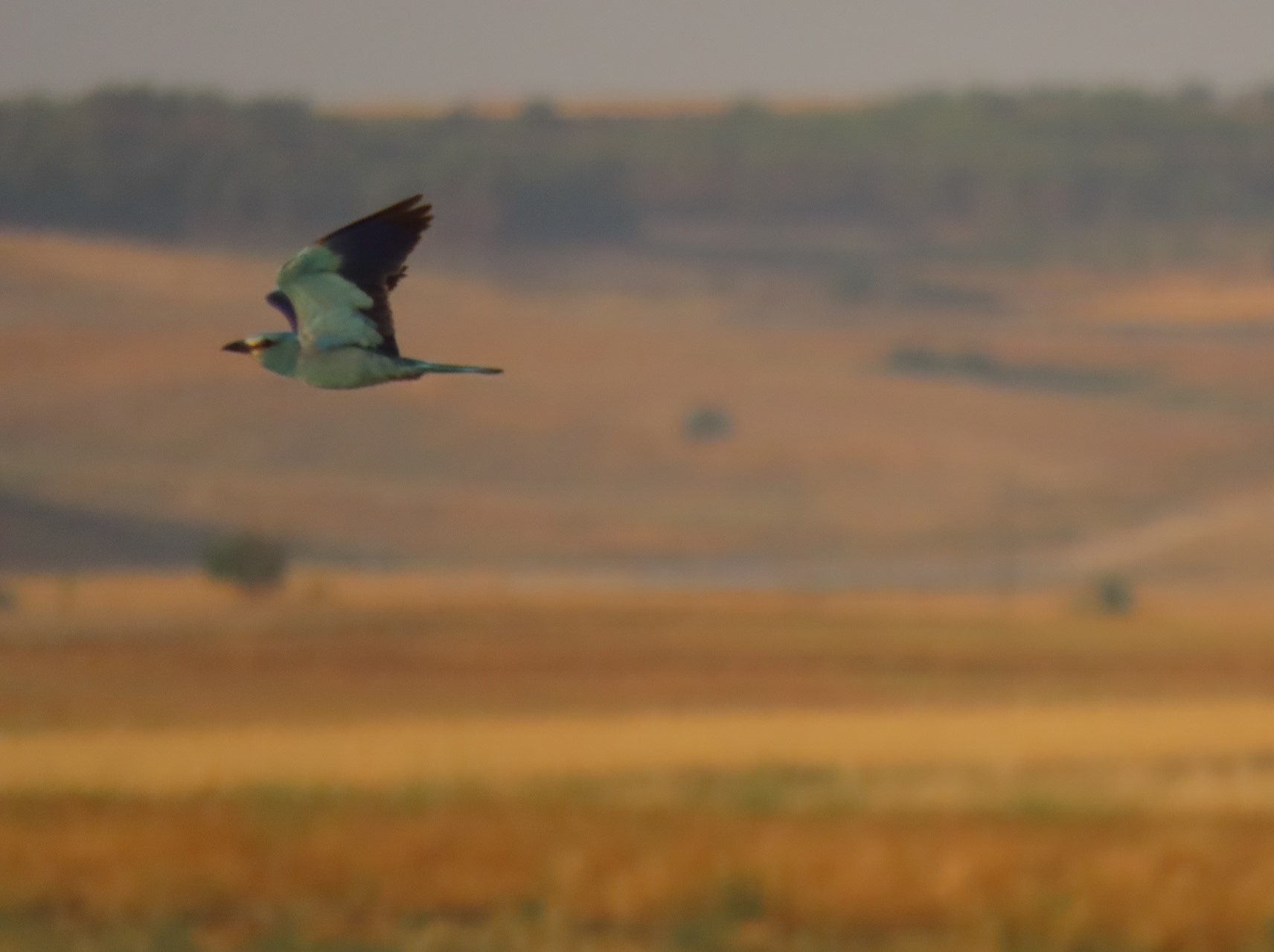
In 2025, we confirmed that the European roller breeding population in the Community of Madrid is in a critical state and requires urgent active habitat management measures. This project is driven by our Corporate Social Responsibility (CSR) commitment, as we believe technical expertise must also be put to the service of conservation.
.png)
Our goal: evaluate to conserve
At Ideas Medioambientales, we work with a clear premise: you cannot conserve what you do not understand in depth. For this reason, during the summer of 2025, we conducted a technical study to evaluate the current status of the European roller (Coracias garrulus) in the Community of Madrid.
Our objective was twofold: first, to update information on their distribution and breeding success; and second, to identify the factors threatening their conservation. The roller is a migratory species linked to traditional agricultural landscapes and is currently classified as “Endangered” in Spain, according to the IUCN Red List and the 2021 Spanish Red Book of Birds. Its trend in the Community of Madrid reflects not only the status of the species but also the profound transformation of our agricultural landscapes.
How we conducted the study
Fieldwork was carried out between June 25 and July 4, 2025, coinciding with the period of highest detectability for the species (the chick-rearing phase). We surveyed 27 UTM 100 km² grid cells, covering a total of 477 kilometers.
We designed the routes based on the optimal habitat available in each grid cell, prioritizing:
Riverine woodlands and riparian vegetation.
Traditional dryland crops.
Areas with nest boxes.
We conducted the surveys by vehicle at low speeds, supplementing with on-foot observations when necessary, using binoculars, a telescope, and GPS georeferencing. This design allowed us to standardize sampling effort and ensure results comparable to previous studies (1994, 2004, and 2016).
Results: three breeding pairs in the entire region
The data obtained confirm a clear and significant decline. In the 27 UTM grid cells surveyed, we detected only three breeding pairs: two in the southeast of the Community of Madrid and one in the neighboring province of Toledo, just a short distance from the regional southwestern border.
The historical contrast in the region is particularly concerning:
1994: 24 UTM grid squares with breeding presence.
2004: 17 grid squares.
2016: 1 notable breeding core.
2025: 3 pairs located.
Furthermore, all pairs detected in 2025 were nesting in artificial nest boxes, which highlights the scarcity of natural cavities available for the species.
During the monitoring, we also observed a summer wildfire in one of the areas with breeding presence, which highlights the extreme fragility of these populations and the habitat in which they live. With such low numbers, any disturbance can compromise the survival of the species at a regional level.
(1).png)
What is happening to the agricultural landscape?
The European roller depends on a mosaic landscape: dryland crops, fallow land, low vegetation, and scattered trees that serve as hunting perches. Agricultural intensification, the shift to irrigation, the removal of field boundaries, and the abandonment of extensive livestock farming have radically altered these conditions.
When herbaceous vegetation grows unchecked or structural elements of the landscape (trees, hedgerows, field margins) are removed, the availability of prey—mainly large insects—decreases, as they become harder to detect, and suitable nesting sites are reduced.
This process does not only affect the European roller, but also other farmland birds with similar ecological requirements, such as the common kestrel (Falco tinnunculus), the lesser kestrel (Falco naumanni), the little owl (Athene noctua) and the Eurasian scops owl (Otus scops). The decline we are observing is, in reality, an indicator of the functional deterioration of the agricultural ecosystem.
What we propose: active management and ecological restoration
Based on the results obtained, we consider it a priority to act along two complementary lines:
1. Increase the availability of nesting sites
- Installation and periodic maintenance of nest boxes
- Conservation and restoration of riparian vegetation
- Planting trees along agricultural boundaries and margins
2. Improve food availability
- Promoting extensive dryland farming
- Recovery of fallow land and vegetated field margins
- Limiting the use of phytosanitary products
- Promoting extensive livestock farming
Our experience with these types of environmental studies confirms that isolated measures are not enough: recovery must be approached through comprehensive land-use planning in which all stakeholders are actively involved.
.png)
Conclusion: a turning point for Madrid's biodiversity
The 2025 census marks a turning point. The European roller is in a critical situation in the Community of Madrid, on the verge of local extinction, but we are still in time to reverse this dire trend if we act with technical expertise and institutional coordination.
At Ideas Medioambientales, we will continue to work on monitoring sensitive species, designing corrective measures, and environmental planning for projects that integrate conservation and territorial development.
Because conserving our biodiversity is not just about protecting a species; it is about restoring the functionality of our landscapes and ensuring their resilience.
.jpeg)
.avif)

.jpeg)


