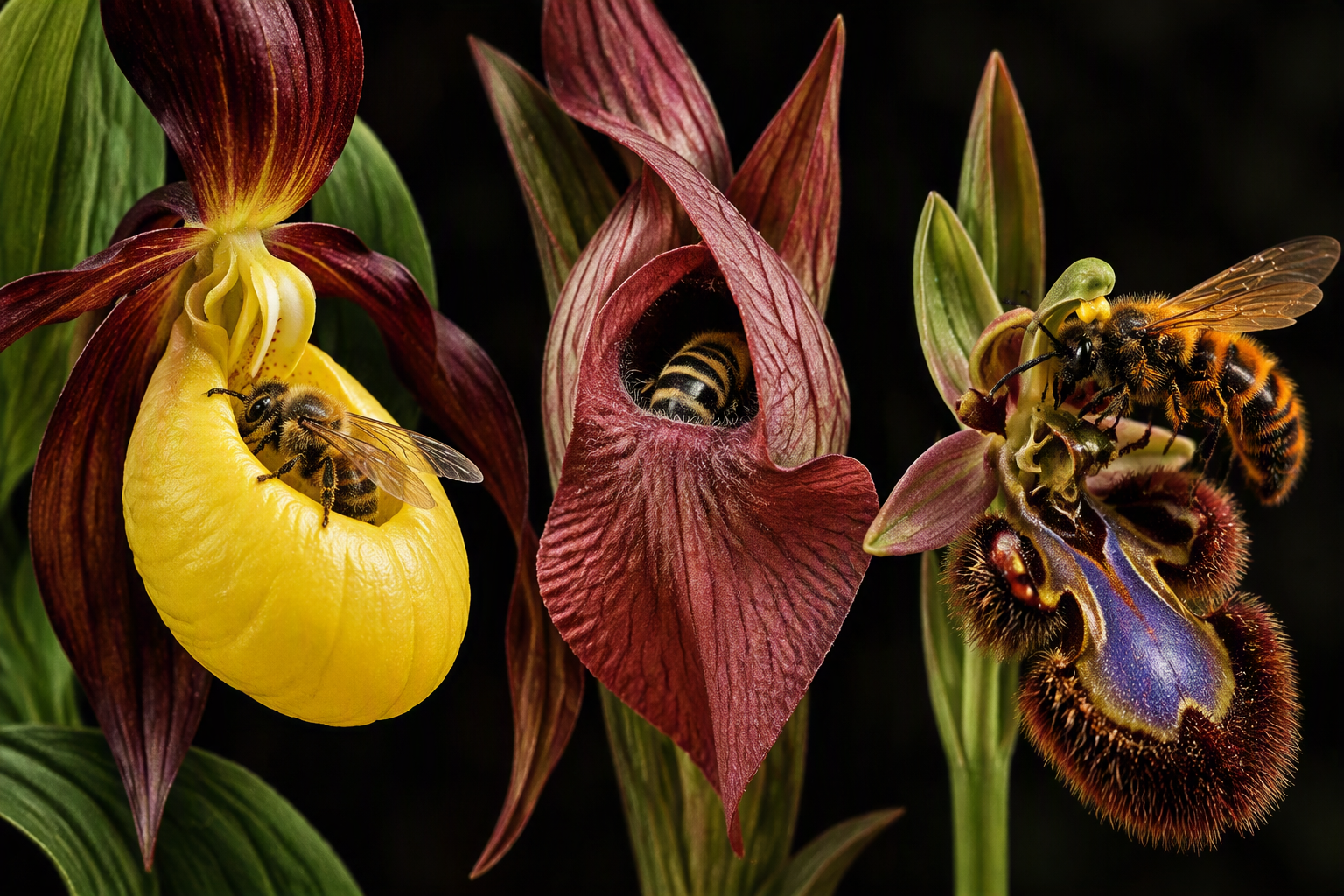


Understanding how orchids and insects interact helps interpret key ecological processes for biodiversity conservation.
Orchids are known for their showy flowers and sophisticated pollination strategies. Some attract insects with scents, colours or food rewards, while others have evolved far more surprising mechanisms.
One of the most fascinating strategies is the floral trap or shelter, a mechanism in which certain insects use the flower as a temporary refuge. During their stay, the plant maximises the chances that pollen will stick to the visitor and be carried to another flower.
From an ecological point of view, these relationships are an excellent example of the close connection between flora and fauna, especially relevant in biodiversity studies, habitat conservation and environmental monitoring. If you want to know more about this group, you can also read our articles (in Spanish) on wild orchids and their small bees, orchid nectar and the distribution of orchids in south-western Spain.
How does a trap flower work?
Orchids that use this strategy usually have floral structures forming cavities, tubes or partially closed chambers.
Insects enter attracted by different stimuli:
- A place to spend the night.
- Protection from adverse weather.
- Visual and aromatic cues.
- Favourable thermal conditions.
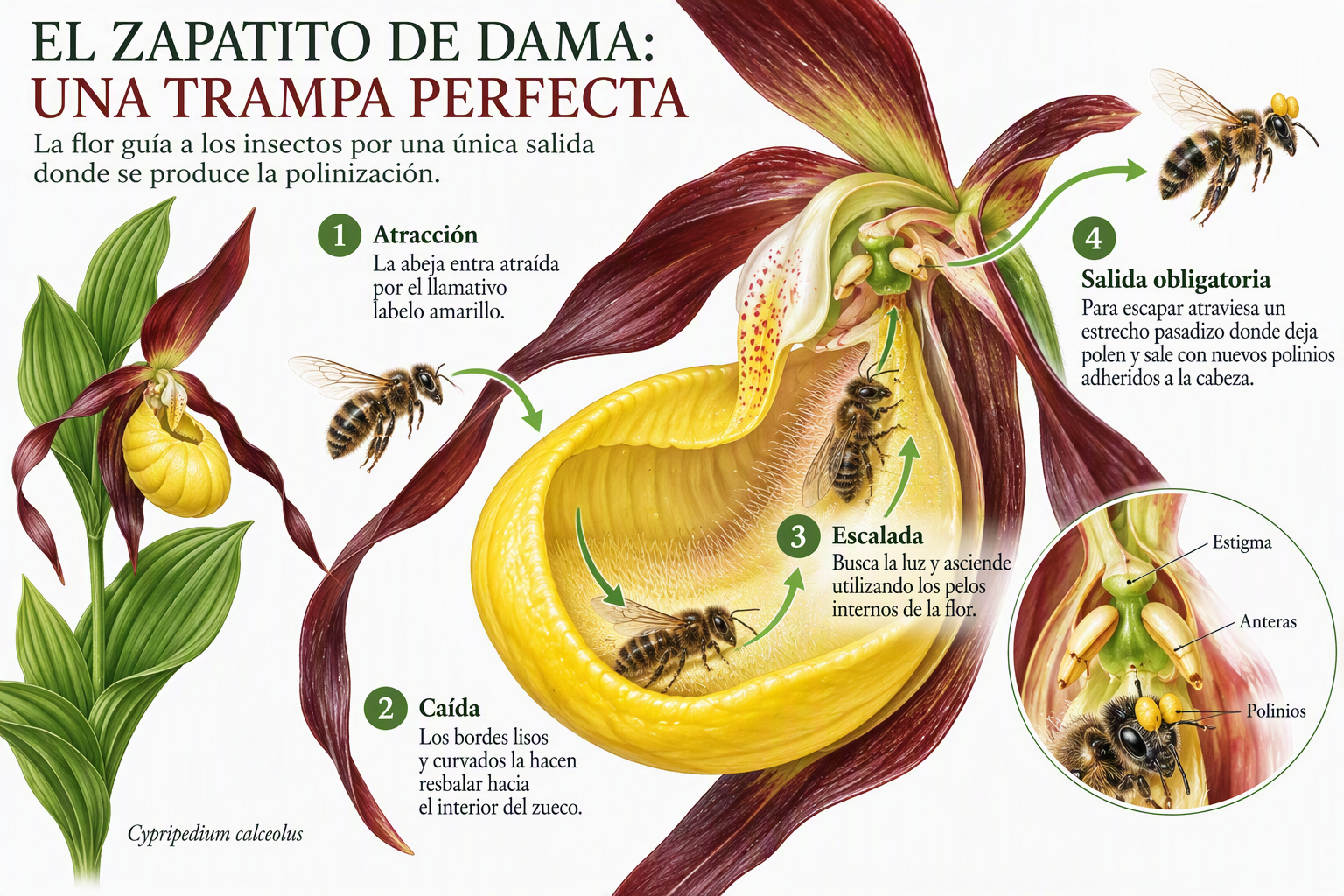
Once inside, the floral architecture briefly hinders the exit and forces the visitor to follow a specific path. During this process, the pollinia come into contact with the insect's body and become attached in a very precise position.
When the insect leaves the flower and visits another plant of the same species, the pollen can be deposited on the stigma, completing pollination.
Serapias: the Mediterranean floral shelter
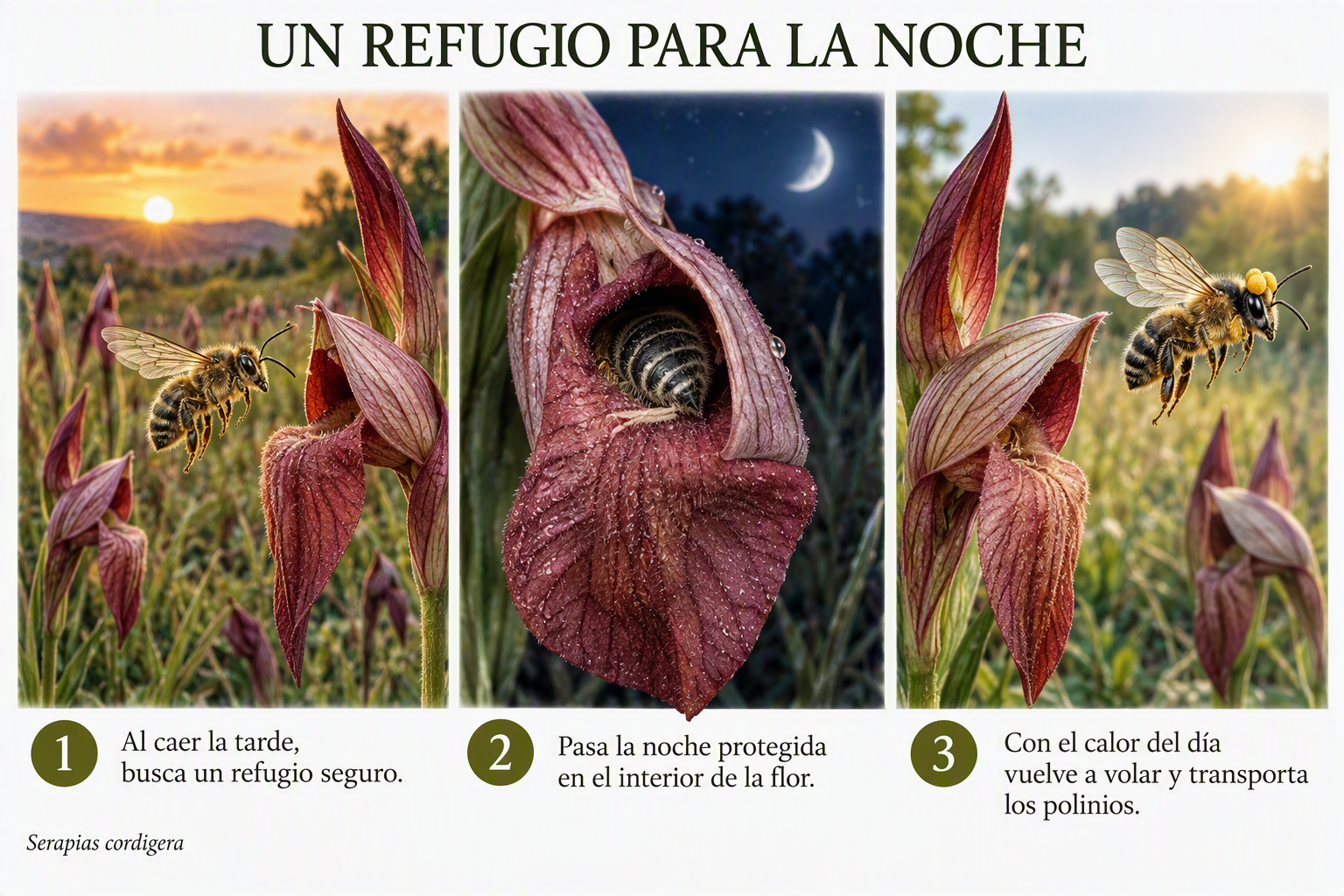
One of the best-known examples in Europe is the genus Serapias, common in grasslands, forest clearings and other Mediterranean habitats.
Its flowers form a tubular structure that works as a temporary shelter for various insects, especially solitary bees and other hymenopterans. These visitors use the flower to rest overnight or to protect themselves from wind and low temperatures.
Far from being a truly harmful trap, the relationship benefits both parties:
- The insect gets temporary shelter.
- The orchid increases its chances of transferring pollen.
This system is a very efficient alternative to producing large amounts of nectar and shows how far orchids have diversified their reproductive strategies.
Other examples of floral retention strategies
Temporary retention of pollinators has appeared independently in many plant groups.
Some tropical orchids of the genus Coryanthes have developed even more complex mechanisms. Insects may fall into chambers filled with liquid and be forced to exit through a specific opening where they pick up the pollinia.
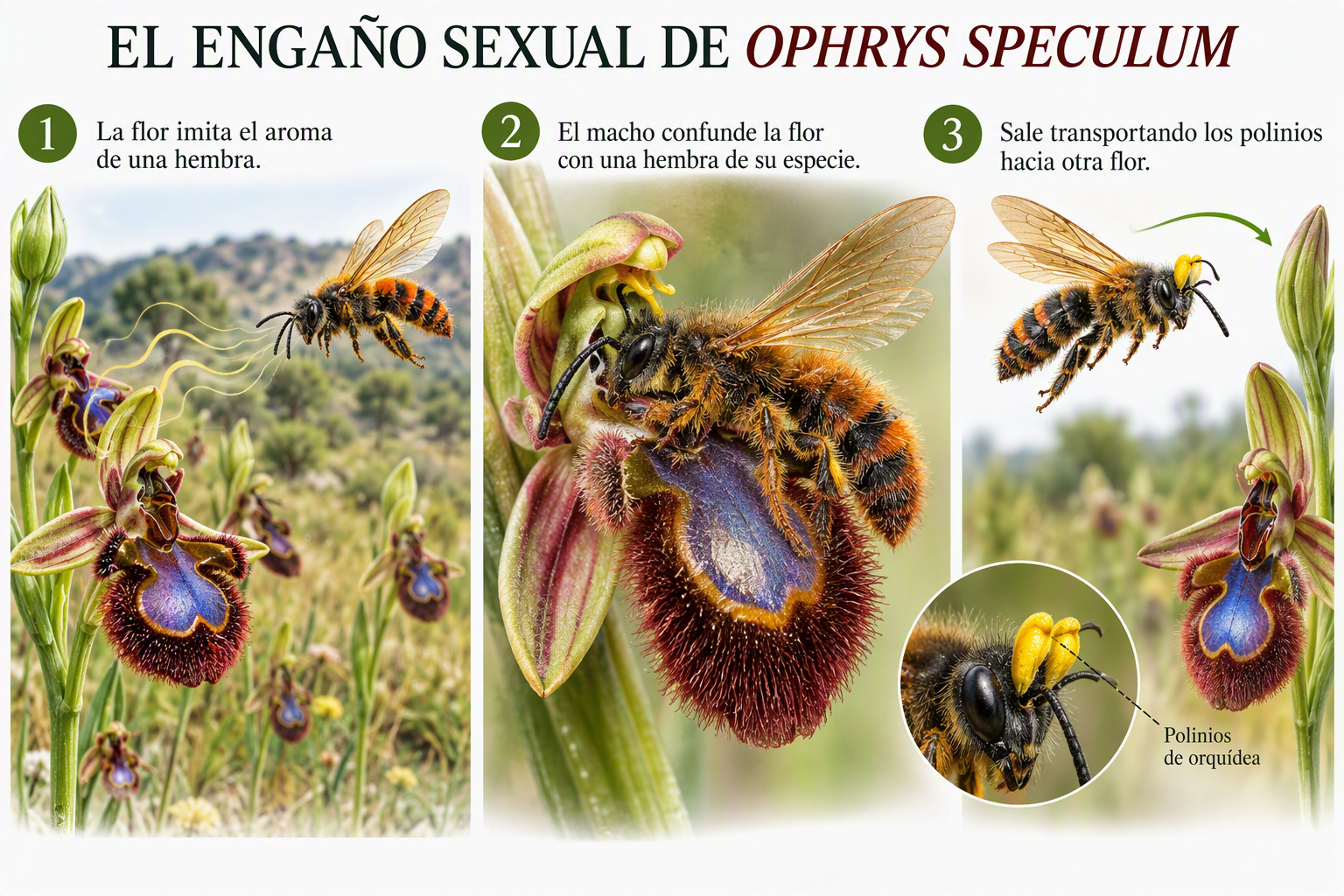
For their part, certain Ophrys species combine extraordinarily precise visual and chemical signals to direct the behaviour of their pollinators through sexual deception.
Although the strategies differ, they all pursue the same goal: to increase the likelihood of effective pollen transfer between flowers.
Why do these strategies matter?
Producing flowers is a high energy investment for any plant. For this reason, orchids have evolved mechanisms that maximise the effectiveness of each insect visit.
Shelter or temporary retention structures make it possible to:
- Increase reproductive success.
- Reduce pollen loss.
- Favour cross-pollination.
- Optimise contact between insect and reproductive organs.
- Improve the precision of pollinia transport.
Each of these adaptations reflects millions of years of co-evolution between plants and pollinators.
Applications in conservation and environmental studies
Orchids depend on complex interactions with fungi, pollinating insects and well-conserved habitats. For this reason, their presence is often associated with functional and ecologically valuable ecosystems.
At Ideas Medioambientales we regularly take part in flora studies, biodiversity inventories and environmental characterisations in which knowledge of these ecological relationships is especially relevant. On pollinators and restoration, see our account (in Spanish) of the conference on pollinators and ecological restoration.
Understanding orchid pollination strategies can help to:
- Assess the conservation status of certain habitats.
- Interpret the functionality of pollinator communities.
- Identify features of biodiversity interest.
- Design ecological conservation and restoration measures.
- Improve the management of natural areas of high environmental value.
Studying these interactions provides valuable information on ecosystem dynamics and supports more effective management measures for the conservation of wild flora and fauna.
Conclusions
Orchids have developed some of the most sophisticated pollination strategies in the plant kingdom. Among them, the use of floral shelters shows how a simple flower can become a key element in the relationship between plants and insects.
Beyond its biological interest, understanding these mechanisms helps us interpret how ecosystems work and provides useful information for the conservation of species, pollinators and habitats. At Ideas Medioambientales we are committed to scientific outreach and technical knowledge as essential tools to protect biodiversity and promote environmental management based on the best available information.
Want to know more?
Here are some scientific references to explore shelter pollination in Serapias and other groups:
- Dafni, A., Ivri, Y. and Brantjes, N.B.M. (1981). Pollination of Serapias vomeracea Briq. (Orchidaceae) by imitation of holes for sleeping solitary male bees (Hymenoptera). Acta Botanica Neerlandica, 30(1/2), 69–73.
- Lanzino, M., Palermo, A.M. and Pellegrino, G. (2023). Pollination mechanism in Serapias with no pollinaria reconfiguration. AoB PLANTS, 15(5), plad054. Popular summary on Botany One.
- Monty, A., Saad, L. and Mahy, G. (2006). Bimodal pollination system in rare endemic Oncocyclus irises (Iridaceae) of Lebanon. Canadian Journal of Botany, 84(8), 1327–1338. An example of shelter pollination outside orchids.