

.avif)

Twain played an emotional trick on us by answering this question: Is Tom Sawyer a book for children, or was it a novel aimed at the child we once were and still carry within us?
A century and a half ago (1886), one of the most luminous, human, and universal novels in modern literature was born: The Adventures of Tom Sawyer, by Mark Twain (1835-1910). Much more than just a story for young people, this immortal work remains a celebration of freedom, imagination, and the deep bond between childhood and nature. In times dominated by haste and screens, returning to Tom Sawyer is a return to the rivers, the trees, the timeless games, and that magical territory where it was still possible to discover the world with the wide-eyed wonder of youth.

That is the goal of today's post: to talk to you and share the essence of one of the most wonderful novels in history, written with the unmistakable stamp of a brilliant author. Mark Twain revolutionized American narrative with literature that was deeply human, ironic, sensitive, and full of social observation. His writing blends humor, adventure, critique, and tenderness, always from a perspective close to the people and their daily lives. Twain understood the landscape—our vital environment—as an essential part of the human soul, and few authors have known how to portray the heartbeat of a land and its people with such power.
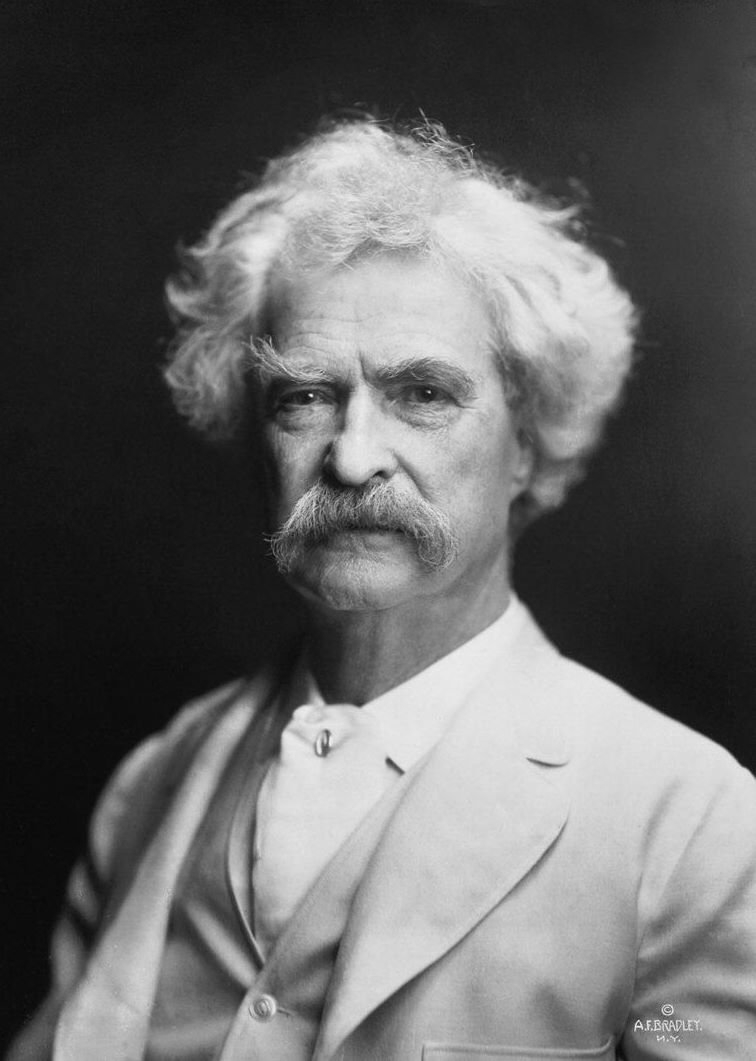
Image 02: Mark Twain, author of Tom Sawyer. A.F. Bradley, New York (Public domain).
In Tom Sawyer, the great protagonist is not just the mischievous boy who defies adult rules, but also the Mississippi River, that immense artery of life that ebbs and flows, connecting towns, stories, and dreams. The river appears as a symbol of freedom, movement, and discovery. Its waters hold the echoes of childhood adventures, makeshift rafts, shared secrets, and open horizons that still know no limits.
The novel conveys a powerful connection with nature. The forests, caves, islands, and riverbanks are part of the emotional universe of Tom and his friends. There, the children play, explore, imagine, and build a world of their own, far from the rigid rules of adults. The childhood Twain describes does not live locked between walls, but rather mixed with the mud, the wind, the insects, the frogs, the birds, the water, and the freedom of endless afternoons.
That is perhaps one of the most beautiful messages of the work: the defense of a free childhood, curious and wild in the best sense of the word. A childhood that resists submitting completely to imposed norms because it needs to discover the mystery of life for itself. And in that, dear readers, Tom Sawyer embodies the childhood we have all wanted to have at some point: brave, dreamy, imperfect, rebellious, and profoundly alive.

One hundred and fifty years after its publication, this book continues to move us because it speaks of something universal that never truly disappears: the human desire for freedom and authentic contact with the natural world. In an increasingly fast-paced society disconnected from the earth, Tom Sawyer reminds us that imagination flourishes by the riverbanks, that friendship is strengthened under the trees, and that the truest happiness is often hidden in the small adventures of childhood: the woods, the cabins, fishing with friends, and the mischief after school.
The significance of this magical work lies precisely in that: in having turned the memory of childhood into an eternal territory. We should have no doubt about that, because as long as there are readers capable of hearing the echo of children's laughter within its pages, Tom Sawyer will continue to run free along the banks of every river in the world.
.jpeg)
.avif)

.jpeg)


